
The Apps That Turn Information Overload Into Long-Term Memory: Best Flashcard Tools for Medical and Law Students
Medical and law students face a problem most ordinary study apps were never designed to handle: massive amounts of information that must remain accessible for months or even years.
This is not casual memorization.
A medical student may need to retain thousands of pharmacology facts, anatomy structures, diagnostic pathways, and clinical associations simultaneously. A law student may need to recall case law, legal doctrines, procedural rules, constitutional tests, and nuanced terminology under intense exam pressure.
That is exactly why spaced-repetition flashcard systems have become almost mandatory in high-volume academic programs.
The best apps do far more than display digital flashcards. They use memory scheduling algorithms that determine precisely when information should be reviewed before it is forgotten. Done properly, spaced repetition dramatically improves long-term retention while reducing wasted study time.
But after testing the major flashcard platforms currently active on the US Apple App Store and Google Play Store in 2026, one thing became very obvious: many apps market themselves as “study tools,” while only a handful genuinely support the brutal long-term retention demands of medical school or law school.
For this guide, the testing focused specifically on spaced-repetition flashcard apps capable of handling dense professional-level study workloads.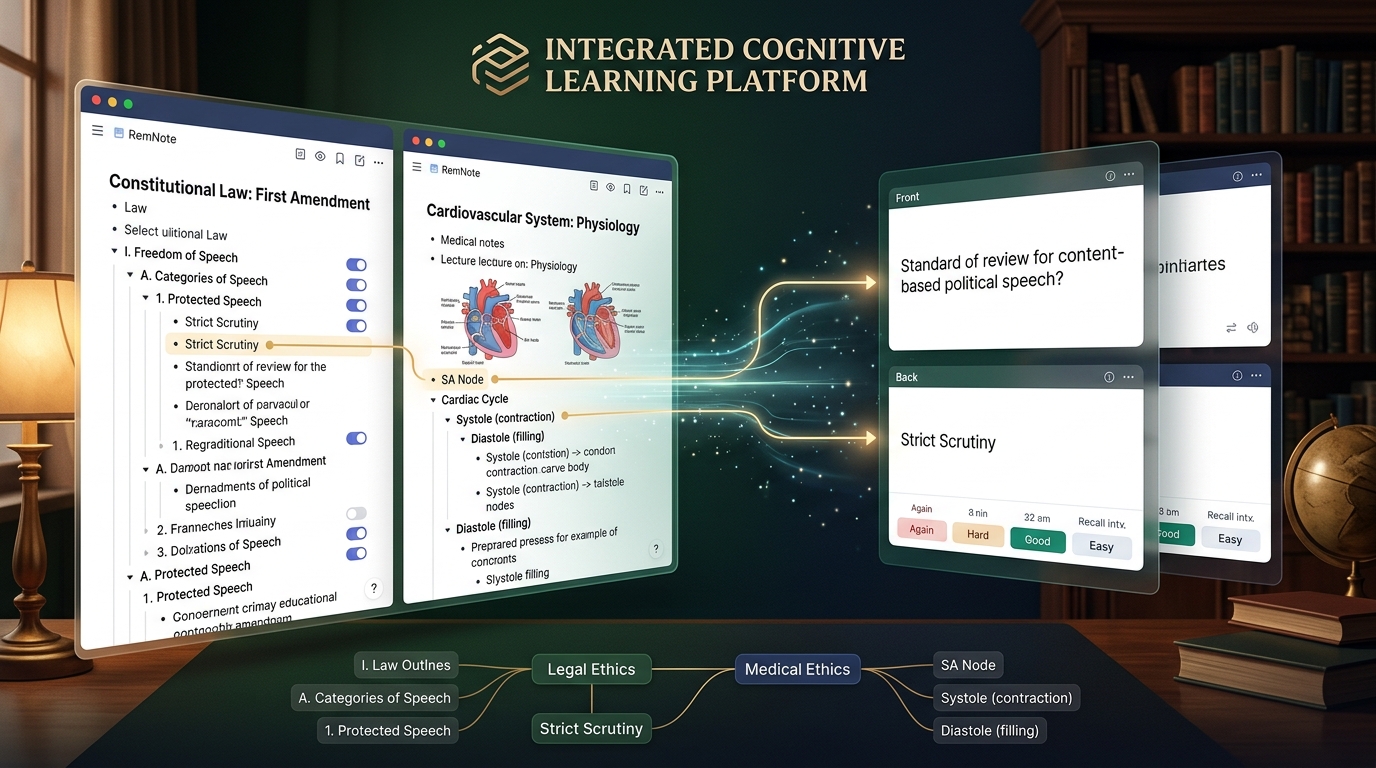
The evaluation criteria included:
Quality of spaced-repetition algorithms
Long-term retention effectiveness
Card customization
Community deck support
Offline functionality
Mobile usability
Pricing transparency
These were the apps that genuinely stood out.
Anki (iOS & Android)
The Reality Check: Still the Gold Standard for Serious Long-Term Memorization
Anki remains the undisputed benchmark for spaced-repetition learning among medical students — and increasingly among law students as well.
The reason is not aesthetics. In fact, Anki still looks dated compared to nearly every competitor tested. But once the actual retention performance becomes clear, the rough interface matters far less. Multiple 2026 comparisons still rank Anki as the strongest overall spaced-repetition system available for high-volume academic study.
During testing, the biggest advantage was flexibility.
Anki supports cloze deletions, image occlusion, audio cards, custom formatting, equations, diagrams, and advanced scheduling through the FSRS algorithm. For medical students, this becomes incredibly powerful when studying anatomy diagrams, pathology slides, biochemical pathways, or pharmacology associations.
The ecosystem is also unmatched.
Large shared decks like AnKing continue dominating medical school communities because thousands of students have refined them collaboratively over years. Law students benefit differently, often creating highly customized doctrine and case-law decks tailored to their courses.
Offline functionality was another major advantage during testing. Once decks are downloaded, the app performs extremely well without internet access.
However, the learning curve is real. Multiple Reddit discussions and study reviews consistently describe Anki as enormously effective but intimidating for beginners.
The desktop and Android versions remain free, while the official iOS app requires a one-time purchase around $24.99.
Pros
Best-in-class spaced repetition
Massive medical deck ecosystem
Extremely customizable
Excellent long-term retention
Strong offline functionality
Cons
Steep learning curve
Outdated interface
Manual setup can be time-consuming
RemNote (iOS & Android)
The Reality Check: The Best Hybrid of Notes and Flashcards
RemNote consistently stood out during testing because it solves one of the biggest frustrations students have with Anki: the separation between note-taking and flashcard creation.
Instead of writing notes first and manually converting them later, RemNote integrates spaced repetition directly into the note-taking workflow. Multiple recent comparisons continue recommending it as the strongest “all-in-one” study system alternative to Anki.
During testing, this workflow felt especially valuable for law students.
Case briefs, outlines, procedural rules, and doctrine summaries could immediately become flashcards while writing notes. That dramatically reduced friction compared to maintaining separate systems.
Medical students also benefit heavily from native image occlusion, hierarchical notes, and diagram support.
The interface itself feels substantially cleaner and more modern than Anki. The onboarding process is also easier for new users who may feel overwhelmed by Anki’s configuration depth.
Another standout feature is adaptive scheduling. The spaced-repetition engine performed reliably throughout testing and adjusted reviews intelligently based on recall difficulty.
However, RemNote still lacks the enormous prebuilt medical deck ecosystem that gives Anki such dominance in med school culture.
The app offers a generous free tier, while Pro subscriptions generally cost around $8 monthly.
Pros
Combines notes and flashcards seamlessly
Modern and cleaner interface
Excellent for law outlines and lecture notes
Strong spaced repetition system
Good image and diagram support
Cons
Smaller shared deck ecosystem
Less customizable than Anki
Advanced features require subscription
Quizlet (iOS & Android)
The Reality Check: The Easiest App to Start Using Immediately
Quizlet remains the most beginner-friendly flashcard platform tested overall.
Almost every student has encountered it at some point because the onboarding process is incredibly simple. Shared decks, collaborative studying, and quick card generation make it highly approachable for overwhelmed students trying to organize material quickly.
During testing, Quizlet performed especially well for short-term memorization and group study situations.
Law students preparing terminology-heavy courses or medical students reviewing foundational definitions may appreciate how quickly decks can be created and shared.
The mobile interface also remains one of the smoothest and most polished in the category.
However, Quizlet’s biggest weakness became obvious during longer-term retention testing: its spaced-repetition system simply is not as sophisticated as Anki or RemNote. Multiple study comparisons and Reddit users repeatedly noted this limitation for serious professional exam preparation.
For intensive multi-year memorization workloads like USMLE preparation or bar exam review, Quizlet often feels more like a convenience tool than a true retention system.
The app offers a free tier, while Quizlet Plus subscriptions generally start around $7.99 monthly.
Pros
Extremely easy to use
Fast deck creation
Strong collaborative features
Excellent mobile interface
Huge library of shared sets
Cons
Weaker spaced-repetition depth
Free version feels increasingly limited
Less effective for long-term retention
Brainscape (iOS & Android)
The Reality Check: The Most Intuitive Review System
Brainscape approaches spaced repetition differently from nearly every competitor tested.
Instead of traditional “Again/Hard/Good/Easy” scheduling, users rate confidence levels from 1 to 5 after reviewing cards. The system then adjusts review frequency accordingly. Multiple 2026 reviews still recommend Brainscape for students who want structured memorization without Anki’s technical complexity.
During testing, the confidence-based system felt surprisingly natural.
The app also includes professionally curated decks for subjects like medical boards, nursing exams, and legal studies, which reduces the setup burden substantially for busy students.
Visually, Brainscape felt cleaner and calmer than Anki throughout testing.
However, customization remains limited compared to Anki’s enormous flexibility. Some advanced students may also find the algorithm slightly less precise during extremely dense review schedules.
The free tier is usable, while Pro subscriptions generally cost around $7.99 to $9.99 monthly depending on plan structure.
Pros
Intuitive confidence-based reviews
Cleaner interface than Anki
Good professionally curated decks
Easy onboarding
Strong mobile experience
Cons
Less customizable
Smaller community ecosystem
Premium tier required for full value
The Final Verdict
For medical and law students handling truly massive long-term memorization demands, Anki remained the strongest overall flashcard app in 2026.
It consistently delivered the best retention performance, deepest customization, strongest scheduling algorithms, and largest academic deck ecosystem during testing. Most importantly, it proved capable of sustaining the enormous multi-year information loads required in medicine and law far better than simpler study apps.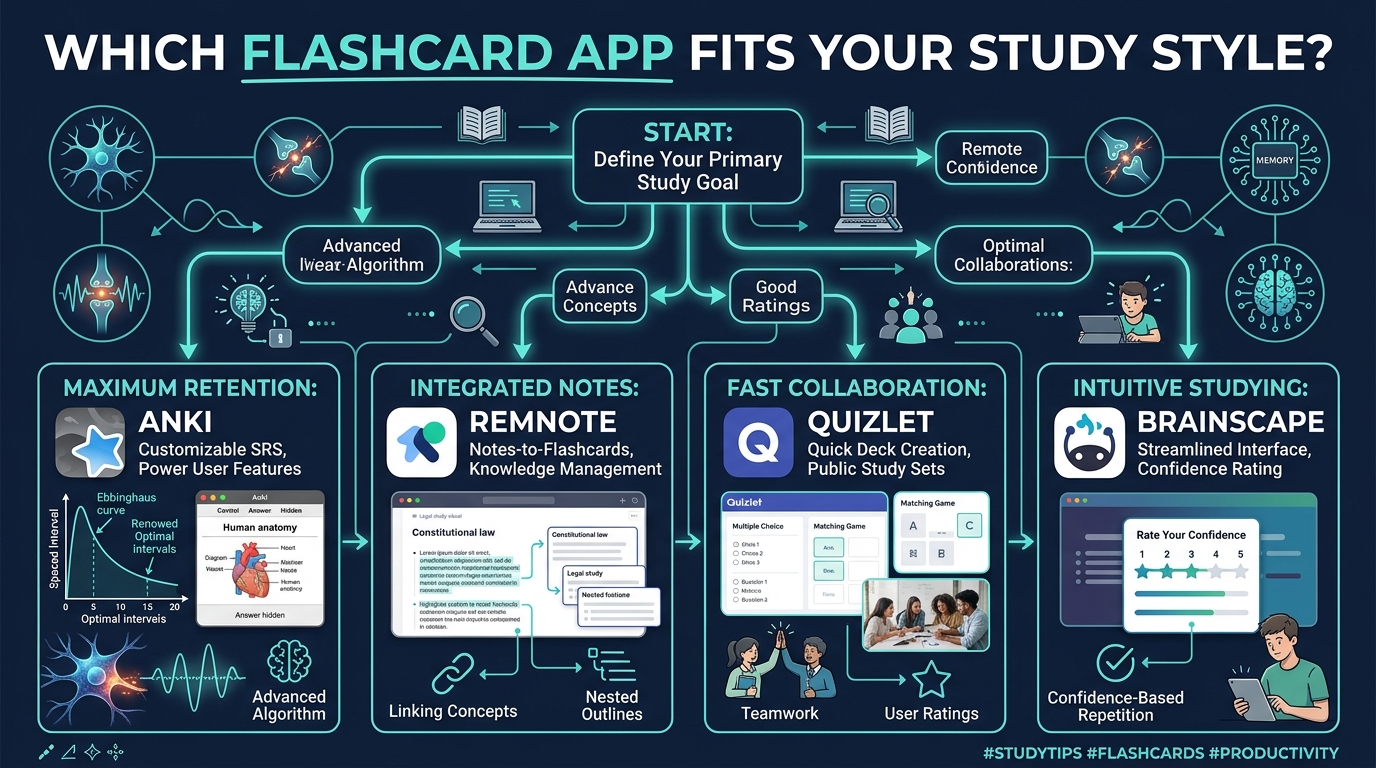
That said, the best platform still depends heavily on study style:
Choose Anki for maximum long-term retention power.
Choose RemNote if integrated note-taking matters most.
Choose Quizlet for fast collaborative studying.
Choose Brainscape for a simpler and more intuitive review experience.
The biggest lesson from testing these platforms is that spaced repetition works best when it becomes part of a consistent daily workflow. The strongest apps are not necessarily the prettiest or easiest — they are the ones students still trust after thousands of cards, hundreds of review sessions, and months of academic pressure.