

No Telescope Required: Top Apps to Map the Entire Night Sky From Your Backyard
There’s a moment almost everyone has had at least once. You step outside on a clear night, look up, and suddenly the sky feels enormous. Thousands of stars. A few unusually bright points of light. Maybe a faint streak moving across the horizon. For about ten seconds, it’s magical.
Then the guessing starts. Is that Venus? Mars? A satellite? Why does everyone else seem to recognize constellations instantly while you’re standing there pretending random stars vaguely resemble a hunter or a bear? Traditional paper star charts don’t help much either. Trying to line up a flat map with the actual night sky in complete darkness usually turns into an exercise in frustration.
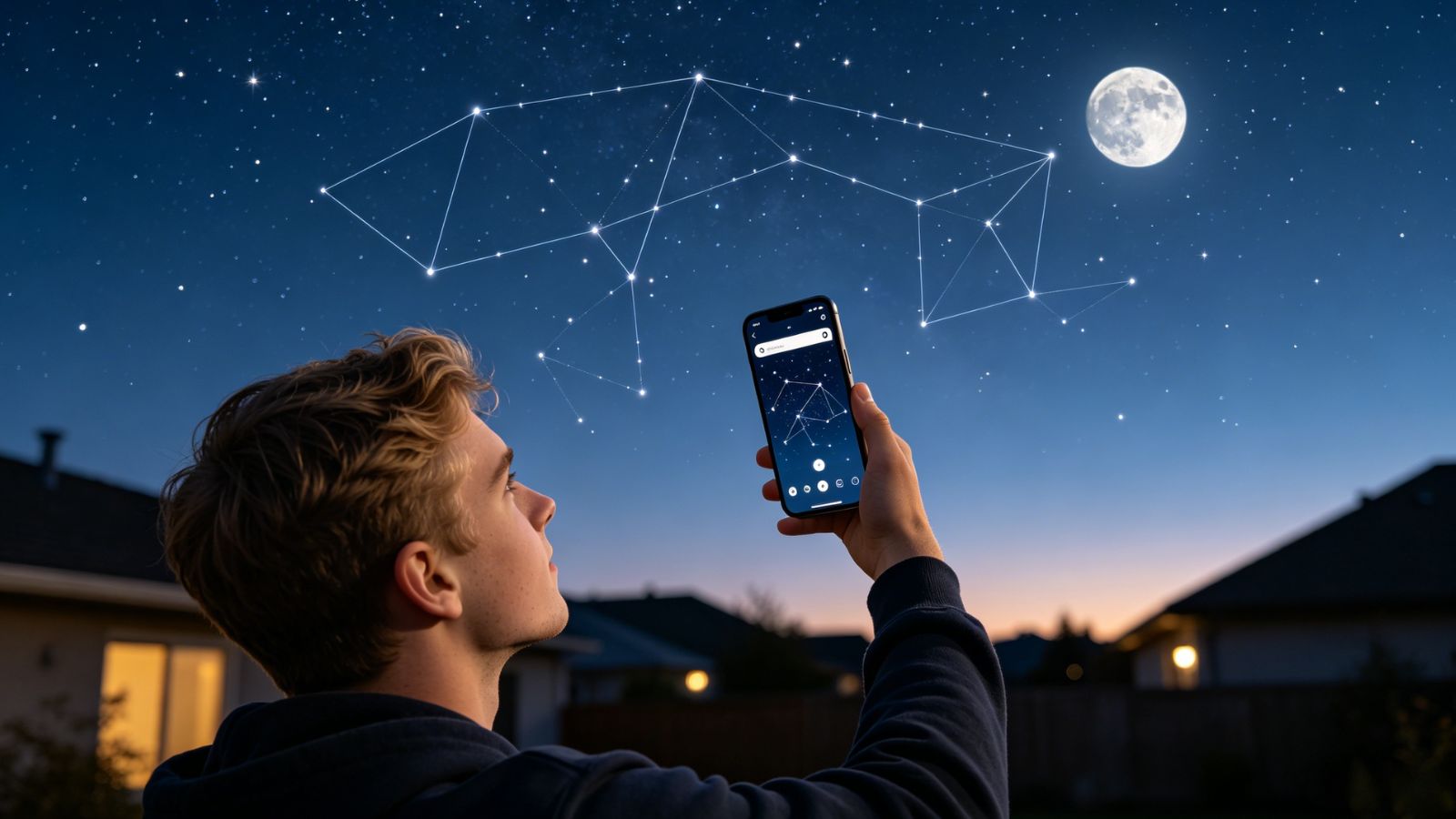
Modern stargazing apps changed that completely. Using your phone’s GPS, compass, and motion sensors, these apps turn the sky into an interactive map. Point your device upward and suddenly constellations appear labeled in real time. Planets snap into place. Satellites glide across the screen. Some apps even simulate meteor showers, eclipses, or the exact position of distant galaxies years into the future. After testing the biggest names across iPhone and Android — focusing on tracking accuracy, interface design, offline reliability, AR performance, and pricing — a few apps clearly rose above the rest.
Stellarium Mobile (iOS & Android)
The app that feels closest to a real observatory tool
Stellarium doesn’t try to gamify astronomy. It treats the sky seriously — and that’s exactly why people love it.
The moment you open the app and point your phone upward, you realize how absurdly detailed it is. Stars aren’t exaggerated cartoon dots floating on a fake blue background. The sky looks dense, textured, and surprisingly realistic, almost like someone peeled back the darkness and exposed the actual mechanics underneath.
What makes Stellarium stand out is precision.
The tracking feels incredibly accurate, especially when identifying planets, star clusters, or dim constellations hiding near the horizon. Amateur astronomers love it because the app scales beautifully from casual stargazing all the way up to telescope work. You can even customize fields of view to match actual telescope hardware, which turns your phone into a legitimate observing companion instead of just a novelty app.
The interface also deserves credit for staying clean. No loud animations. No cluttered “space facts” popping up every few seconds. It trusts the sky to be interesting on its own.
The downside is that some of the deeper astronomy catalogs and advanced telescope features sit behind a paid upgrade. And compared to more cinematic apps, Stellarium can feel a little clinical at times.
Still, if accuracy matters most, this is the one to beat.
What stands out
Extremely accurate real-time sky simulation
Fantastic for both beginners and serious astronomy hobbyists
Telescope customization tools are genuinely useful
Minimal, distraction-free interface
Where it struggles
Advanced object databases require a premium upgrade
Less visually dramatic than more entertainment-focused apps
Sky Guide (iOS)
The most beautiful stargazing app on mobile
Sky Guide feels less like software and more like an experience.
Everything about it is polished. Constellations fade smoothly into view as you move your phone. Ambient music shifts subtly while you scan different parts of the sky. Even tiny details — like the way stars shimmer during movement — make the app feel oddly calming.
For casual stargazing, it’s probably the most enjoyable app to use.
The satellite tracking is especially impressive. Sky Guide can notify you before the International Space Station passes overhead, and watching it glide across the sky while the app tracks it in real time never really stops being cool.
One of the best features is the “Time Machine” mode. You can fast-forward through future eclipses, meteor showers, or planetary alignments and watch the sky evolve across months or even years. It turns astronomy into something interactive instead of static.
The biggest drawback is obvious: it’s locked entirely inside Apple’s ecosystem. Android users are out immediately. Some of the premium educational content also lives behind subscriptions, which can get frustrating over time.
But visually? Few astronomy apps feel this refined.
What stands out
Gorgeous interface and smooth animations
Excellent satellite and ISS tracking
Fantastic night mode that preserves dark vision
Time-travel sky simulation is genuinely addictive
Where it struggles
Apple-only
Some premium content requires ongoing subscriptions

Sky Tonight (iOS & Android)
Best for people who actually plan stargazing sessions
Sky Tonight is built for people who don’t just randomly glance upward — they actively plan nights around astronomy.
Its smartest feature is the Stargazing Index. Instead of only showing constellations, the app calculates visibility conditions using cloud cover, moon brightness, weather, and local light pollution. In other words, it tells you whether tonight is actually worth dragging a telescope outside for.
That sounds simple, but it’s ridiculously useful.
The search tools are also excellent. You can type broad things like “meteor showers,” “planet alignments,” or “eclipses,” and the app immediately surfaces upcoming events without making you dig through menus.
The AR mode works well too. Point your phone upward, and the overlays remain surprisingly stable instead of drifting awkwardly across the screen like some cheaper apps.
The only issue is complexity. Sky Tonight packs in so many tools and layers that new users can feel overwhelmed during the first few sessions. It’s powerful, but definitely less beginner-friendly than something like SkyView.
What stands out
Excellent visibility forecasting tools
Great event-planning features for serious observers
Stable AR sky tracking
Flexible search system for celestial events
Where it struggles
Dense interface with a learning curve
Ads and locked encyclopedia features in the free version
SkyView (iOS & Android)
The easiest app to recommend to complete beginners
SkyView understands something important: most people don’t want a full astronomy course. They just want to know what they’re looking at.
Open the app. Point your phone at the sky. Done.
That simplicity is SkyView’s biggest strength.
The app works beautifully offline too, which makes it fantastic for camping trips, hiking trails, or remote areas where cell service disappears completely. Even without Wi-Fi or data, it can still identify stars, planets, and constellations using your device’s sensors alone.
The constellation overlays are intentionally clean and easy to read, which makes the app especially good for kids or anyone completely new to stargazing.
Compared to Stellarium or Sky Tonight, though, the underlying astronomy database feels smaller. Hardcore space enthusiasts will eventually notice missing deep-sky objects or less detailed celestial information. The visuals also look a little dated compared to newer competitors.
Still, for fast, stress-free constellation identification, it’s excellent.
What stands out
Extremely beginner-friendly
Works reliably without internet access
Clean, simple constellation overlays
Affordable one-time premium option
Where it struggles
Smaller astronomy database
Graphics feel slightly older compared to newer apps
Star Walk 2 (iOS & Android)
Best for people who want astronomy to feel interactive
Star Walk 2 leans heavily into the educational side of stargazing — and honestly, it works.
Tap a planet, and the app smoothly zooms into a rotating 3D model. Select a constellation, and suddenly you’re reading mythology, astronomy history, and detailed scientific explanations all inside the same interface. It feels more like an interactive museum than a traditional star map.
That makes it especially good for families, students, or curious beginners who want context alongside identification.
The sound design is surprisingly fun too. The app plays subtle audio cues as your phone crosses major celestial objects, which gives the experience a slightly cinematic feel without becoming annoying.
The biggest issue is monetization. The free version pushes ads pretty aggressively, which can completely ruin your night vision during dark outdoor sessions. Expansion packs are also sold separately, and costs start stacking up quickly if you unlock everything individually.
Still, as a learning tool, Star Walk 2 is genuinely engaging.
What stands out
Excellent educational content and 3D models
Fun interactive approach to astronomy
Smooth performance across most devices
Great for younger users and families
Where it struggles
Ads can become intrusive during nighttime use
Expansion packs add up financially over time
Which app is actually the best?
For overall balance — accuracy, usability, realism, and long-term value — Stellarium Mobile still comes out on top.
It respects the night sky instead of turning it into a flashy mobile game. The tracking is reliable, the data is deep, and the app scales beautifully whether you’re casually identifying Orion from your backyard or aligning an actual telescope in the middle of nowhere.
That said, the “best” app depends heavily on what kind of stargazer you are.
If you want the most visually immersive experience possible, Sky Guide is stunning. If you love planning meteor showers and tracking visibility conditions, Sky Tonight is incredibly useful. And if you simply want something fast, lightweight, and beginner-friendly, SkyView is hard to beat.
Either way, these apps completely change the experience of looking up at the night sky. Once you can finally identify what you’re seeing, the stars stop feeling random — and start feeling connected.