
The 15-Minute MBA: Best Apps for Absorbing Non-Fiction Books Faster Than Ever
Most people genuinely want to read more non-fiction books.
The problem is not motivation. It is time.
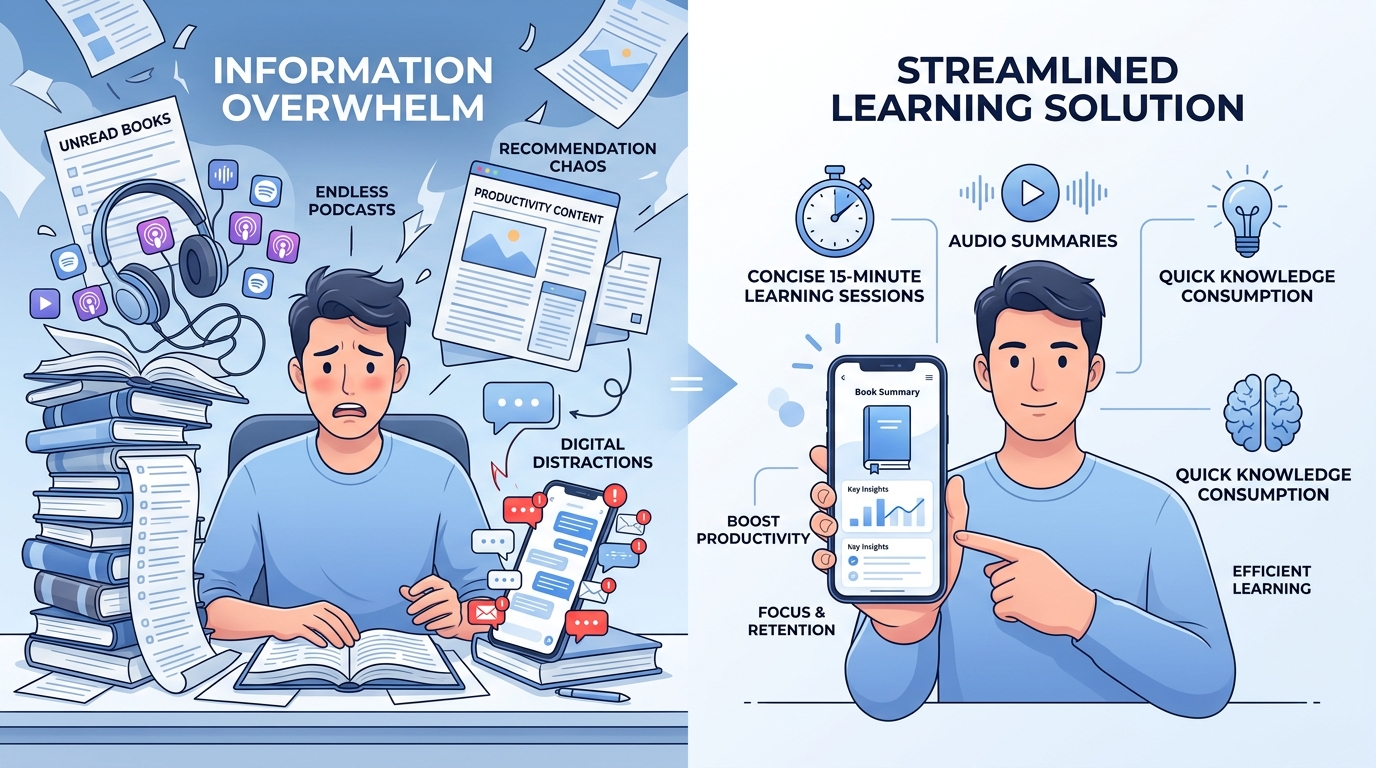
Modern readers are buried under recommendation lists, productivity podcasts, business books, psychology bestsellers, health guides, leadership frameworks, and self-improvement titles that all promise life-changing insights — while most adults barely have enough uninterrupted time to finish a single full-length book every month.
That frustration is exactly why non-fiction summary apps have exploded in popularity over the past few years.
The best apps now condense bestselling books into 10-to-20-minute text and audio summaries that can realistically fit into commutes, workouts, errands, or lunch breaks. But after testing the major summary platforms currently active on the US Apple App Store and Google Play Store in 2026, one thing became very clear: many apps oversimplify books into motivational fluff, while only a few genuinely preserve the useful ideas.
For this guide, the testing focused specifically on apps that deliver high-quality non-fiction summaries in roughly 15 minutes through readable text, audio narration, or both.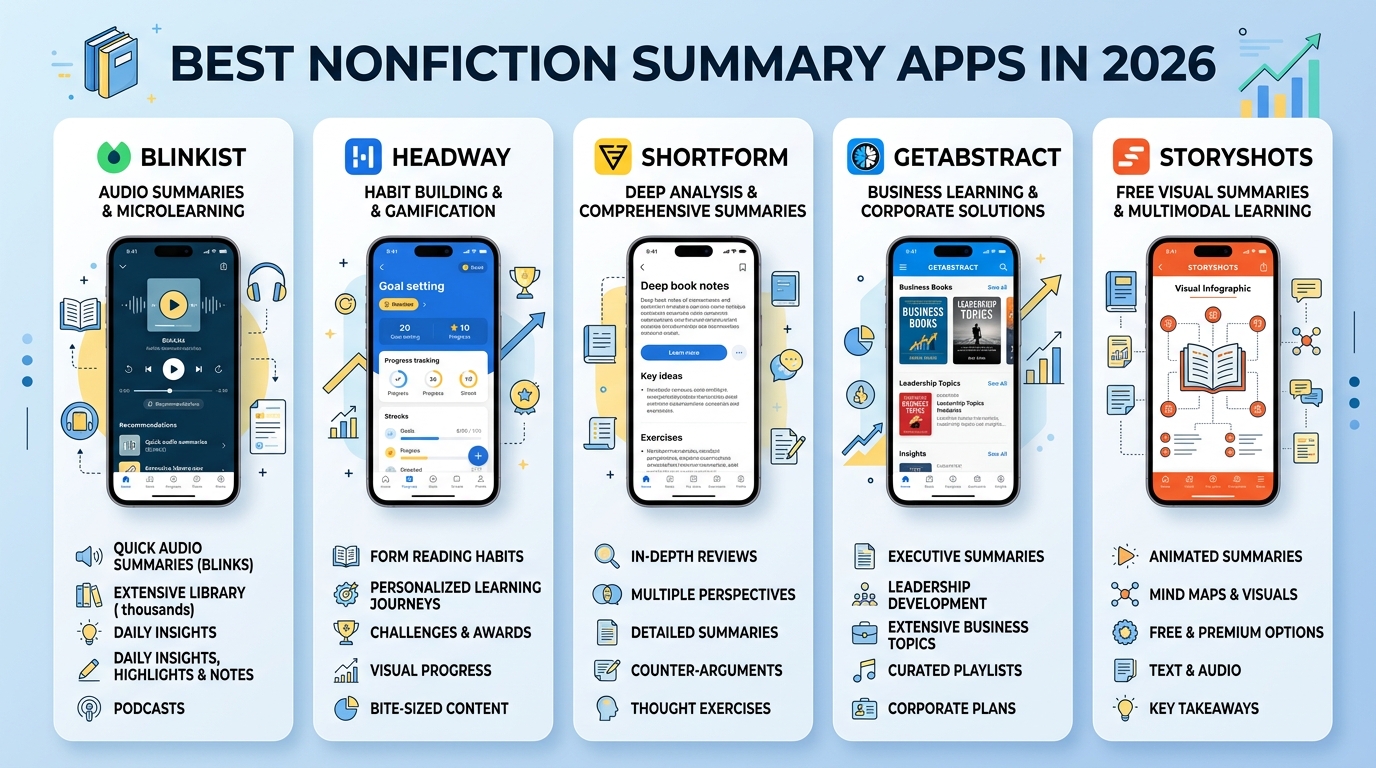
The evaluation criteria included:
Summary quality and accuracy
Audio listening experience
App usability
Variety of non-fiction categories
Learning retention tools
Pricing transparency
Long-term value
These were the apps that genuinely stood out.
Blinkist (iOS & Android)
The Reality Check: Still the Most Polished Overall Experience
Blinkist remains the dominant name in book summaries for a reason.
After extensive testing, it consistently delivered the most refined combination of readability, narration quality, app design, and library depth. Multiple independent reviews still rank Blinkist among the strongest non-fiction summary platforms available in 2026.
The app specializes in “Blinks” — condensed versions of popular non-fiction books that typically take around 15 minutes to read or listen to.
During testing, the summaries generally did an excellent job extracting actionable concepts without feeling aggressively watered down. Categories like business, psychology, productivity, finance, leadership, and personal development were especially strong.
The audio experience also stood out immediately. Narration sounded professional and natural rather than robotic, making Blinkist genuinely useful during commutes or workouts.
Another major advantage is consistency. The interface feels extremely polished across both iPhone and Android, and downloading summaries for offline listening worked smoothly throughout testing.
However, Blinkist occasionally prioritizes mainstream productivity titles over deeper or more academic non-fiction. Readers looking for highly technical material may eventually hit limitations.
The app offers limited free daily summaries, while premium subscriptions generally cost around $15.99 monthly or discounted annual plans.
Pros
Excellent audio narration
Highly polished user experience
Strong productivity and business catalog
Reliable offline listening
Consistently readable summaries
Cons
Expensive subscription
Less academic depth
Heavy focus on mainstream bestsellers
Headway (iOS & Android)
The Reality Check: The Most Addictive Learning Experience
Headway approaches book summaries differently from Blinkist.
Instead of feeling like a digital library, the app feels closer to a habit-building learning platform designed around daily personal growth. Multiple app reviewers still rank Headway among the most engaging micro-learning apps currently available.
During testing, the biggest difference was pacing and presentation.
Headway breaks lessons into visually dynamic sections filled with highlights, quotes, progress tracking, spaced repetition, and quick motivational reinforcement. For users who struggle maintaining reading habits, this structure genuinely helps sustain engagement.
The summaries themselves are concise and easy to digest quickly. Audio narration was also solid during testing, although slightly less polished overall than Blinkist.
Another standout feature is personalization. The app aggressively tailors recommendations around goals like productivity, confidence, communication, leadership, or financial improvement.
However, the platform sometimes leans too heavily into motivational self-help culture. Readers looking for broader intellectual non-fiction or nuanced long-form ideas may find the tone repetitive over time.
The app operates primarily through subscription pricing, typically around $12.99 monthly depending on promotions and annual plans.
Pros
Extremely engaging interface
Strong habit-building design
Good audio summaries
Fast and approachable learning
Personalized recommendation system
Cons
Heavy self-improvement focus
Less intellectually broad
Frequent subscription upsells
Shortform (iOS & Android)
The Reality Check: The Best App for Readers Who Want More Than Surface-Level Summaries
Shortform consistently delivered the deepest and most intellectually detailed summaries tested overall.
Unlike many competitors focused strictly on speed, Shortform expands books with chapter breakdowns, context explanations, exercises, related ideas, and analytical commentary. Several comparison reviews specifically recommend Shortform for serious readers who still want condensed learning.
During testing, this difference became obvious immediately.
Summaries felt far more comprehensive than Blinkist or Headway. Instead of simply extracting “key takeaways,” Shortform often explains why ideas matter, how concepts connect, and where authors disagree with competing viewpoints.
The app was especially strong for books covering psychology, business strategy, philosophy, behavioral science, and finance.
Another standout feature is the inclusion of exercises and reflection prompts that improve retention substantially better than passive listening alone.
However, Shortform’s deeper approach creates tradeoffs.
The experience is slower, denser, and less casual than competitors built around ultra-fast consumption. Many summaries also extend beyond the typical 15-minute format.
Pricing is also relatively expensive, with subscriptions generally around $24 monthly or discounted annual options.
Pros
Deep and thoughtful summaries
Excellent contextual explanations
Strong learning retention tools
Better intellectual depth
High-quality analysis
Cons
Less lightweight and casual
More time-intensive
Premium pricing is high
getAbstract (iOS & Android)
The Reality Check: Best for Professional and Business-Focused Readers
getAbstract felt noticeably more corporate and career-oriented than most competitors tested.
The platform specializes heavily in business, leadership, management, communication, finance, and workplace development summaries. Many enterprise learning programs and professional organizations still use getAbstract extensively in 2026.
During testing, the summaries consistently felt concise, professional, and practical.
The app performs especially well for readers looking to extract business insights efficiently without spending hours on full-length management books.
Audio summaries were clear and functional, although less polished emotionally than Blinkist. The overall interface also feels more utilitarian than modern lifestyle-focused competitors like Headway.
One major advantage is library breadth for professional development topics. Leadership, negotiation, communication, productivity, and organizational psychology categories were particularly strong during testing.
However, casual readers may find the platform overly corporate. The visual design also feels slightly dated compared to newer competitors.
Subscriptions generally cost around $29.90 monthly depending on plan structure and enterprise access.
Pros
Excellent business-focused content
Strong professional development library
Concise and practical summaries
Reliable audio playback
Trusted by enterprise users
Cons
Expensive pricing
Less appealing for casual readers
Interface feels somewhat outdated
StoryShots (iOS & Android)
The Reality Check: The Best Free Alternative
StoryShots stood out immediately because it offers an unusually large amount of free content compared to competitors.
The app provides text, audio, infographic, and animated summaries across productivity, psychology, business, health, and personal development categories. Several review roundups continue recommending StoryShots as one of the strongest budget-friendly summary apps available.
During testing, the variety of formats genuinely helped retention. Some users may absorb ideas better through infographics or animated explanations than traditional audio summaries.
The app also performed surprisingly well for casual learning sessions. Browsing summaries felt lightweight and accessible rather than academically intimidating.
However, quality consistency varied more than premium competitors. Some summaries felt highly polished, while others lacked the editorial depth found in Blinkist or Shortform.
Audio narration quality also fluctuated noticeably depending on the title.
The app offers a free version with optional premium upgrades and subscriptions for expanded features.
Pros
Strong free content selection
Multiple learning formats
Easy casual browsing
Good accessibility for beginners
Broad topic variety
Cons
Inconsistent summary quality
Audio narration varies
Less editorial polish
The Final Verdict
For readers specifically looking to absorb high-quality non-fiction insights in roughly 15 minutes, Blinkist remained the strongest overall option in 2026.
It consistently delivered the best balance of readability, audio quality, usability, and content consistency during testing. Most importantly, it made learning feel frictionless enough to realistically become part of a daily routine.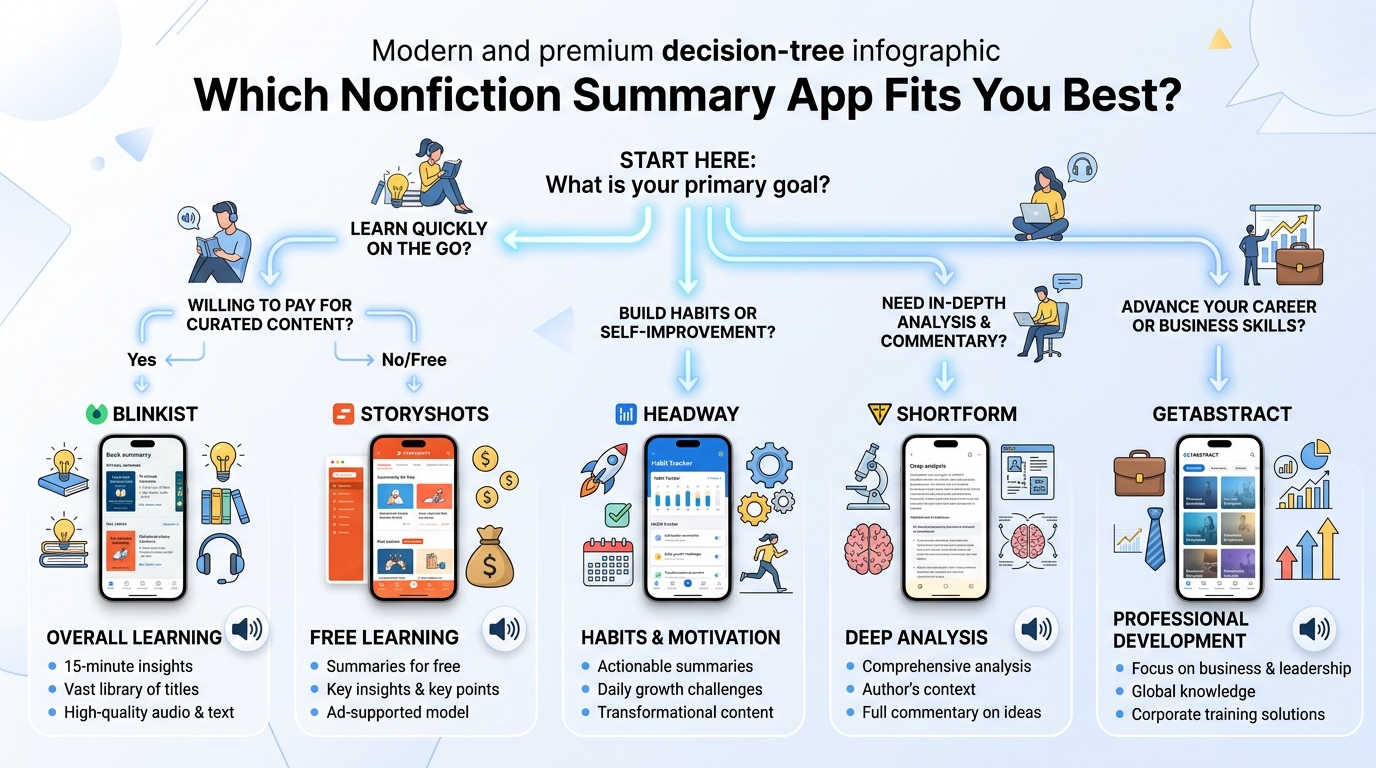
That said, the best app still depends heavily on reading style and learning goals:
Choose Blinkist for the best all-around summary experience.
Choose Headway for habit-building and motivational learning.
Choose Shortform for deeper intellectual analysis.
Choose getAbstract for professional and business development.
Choose StoryShots for the best free alternative.
The biggest lesson from testing these apps is that summary platforms work best when treated as discovery tools rather than replacements for full books. The strongest apps do not simply compress information — they help busy people learn consistently in a world overflowing with ideas.