
From Blundering the Opening to Winning the Endgame: The Chess Apps That Actually Improve Real Players
Most chess players eventually hit the same frustrating wall.
They play hundreds of online games, memorize a few opening moves from YouTube, solve occasional puzzles, and still keep losing in the same ways: weak middlegame plans, forgotten opening lines, missed tactical patterns, and completely collapsing in endgames.
That frustration is exactly why specialized chess training apps have become dramatically more sophisticated over the past few years.
The best apps no longer focus only on casual play. They now offer opening repertoires, spaced-repetition move training, endgame drills, engine analysis, tactical pattern recognition, and structured learning systems designed for actual long-term improvement.
But after testing the major chess learning apps currently active on the US Apple App Store and Google Play Store in 2026, one thing became very obvious: many apps are excellent for casual puzzles but surprisingly weak for systematic opening preparation or serious endgame training.
For this guide, the testing focused specifically on apps that help players learn chess openings efficiently and practice specific endgame tactics repeatedly until they become instinctive.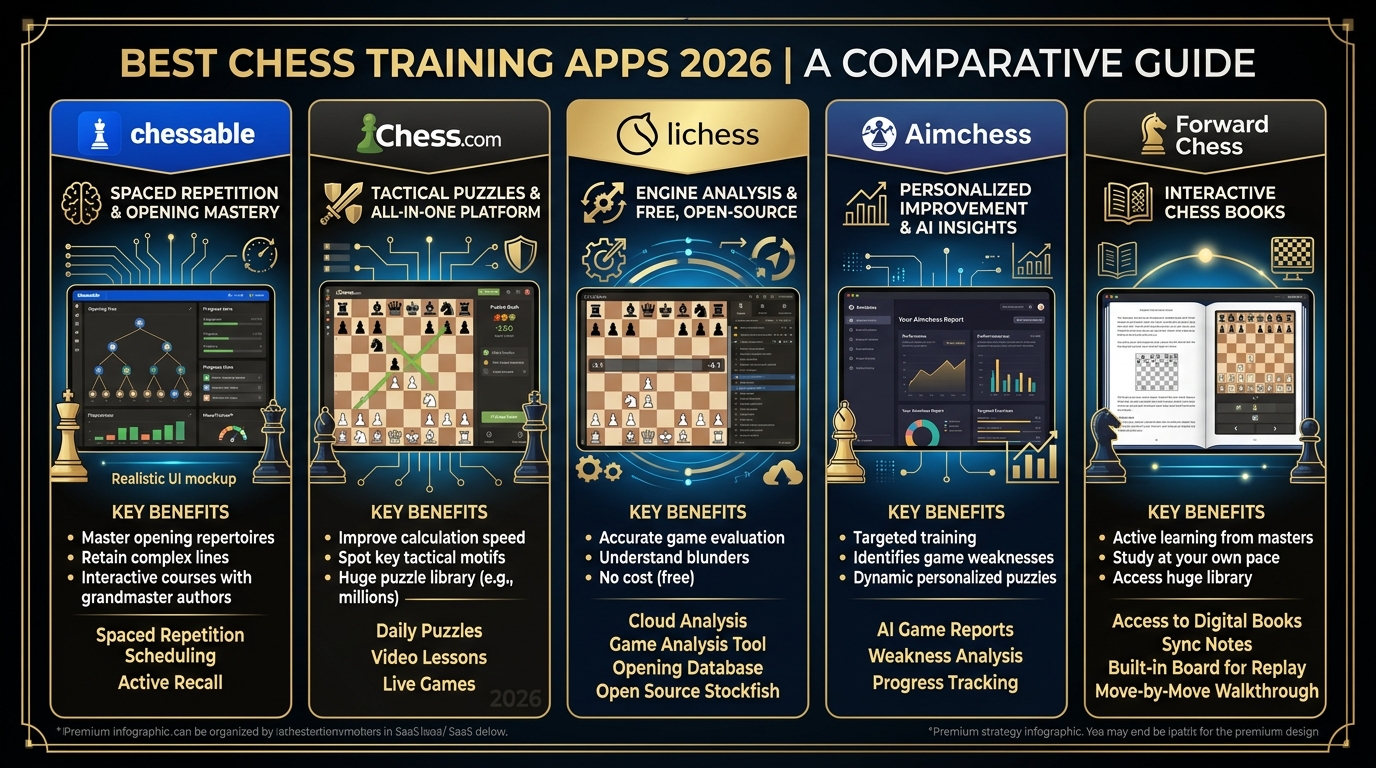
The evaluation criteria included:
Opening training quality
Endgame practice tools
Tactical training depth
Engine analysis usefulness
Mobile usability
Learning progression systems
Pricing transparency
These were the apps that genuinely stood out.
Chessable (iOS & Android)
The Reality Check: The Best Structured Opening Trainer Available
Chessable consistently delivered the strongest overall learning system for openings and long-term chess memory retention.
The platform’s biggest advantage is its “MoveTrainer” system, which uses spaced repetition to repeatedly test players on opening lines and tactical sequences until the moves become automatic. Multiple independent chess communities still consider Chessable one of the strongest opening-training tools available in 2026.
During testing, this approach worked exceptionally well.
Instead of passively reading opening theory, players are forced to actively recall moves against computer responses. That creates much stronger retention than watching videos alone.
The app also has an enormous library of opening repertoires and endgame courses created by titled players and grandmasters. Popular repertoires for the Sicilian Defense, London System, Caro-Kann, Queen’s Gambit, and countless other openings are all available with guided training systems.
Endgame content was also surprisingly strong. Courses covering king-and-pawn endings, rook endings, opposition, triangulation, and practical conversion techniques felt far more structured than most competitors.
However, the platform can become expensive quickly. Many premium repertoires and advanced courses require separate purchases or subscriptions.
The app includes free introductory content, while premium courses and Chessable Pro features vary widely in price depending on content packages.
Pros
Excellent spaced-repetition training
Best opening memorization system tested
Huge library of grandmaster courses
Strong endgame instruction
Very effective active recall design
Cons
Premium courses become expensive
Interface can initially feel overwhelming
Some courses vary in teaching quality
Chess (iOS & Android)
The Reality Check: The Best All-in-One Chess Improvement Platform
Chessremains the most complete all-around chess app for most players.
While many serious players criticize it for being too mainstream, extensive testing showed that its training ecosystem is genuinely impressive for players below advanced tournament level. The platform combines lessons, opening drills, puzzles, endgame training, bots, engine analysis, and live play inside one polished interface.
During testing, the opening explorer proved especially useful for practical learning.
Players can quickly study common lines, review master games, and test opening responses interactively. Puzzle Rush and tactical drills also remained highly addictive while still improving pattern recognition meaningfully over time.
Another standout feature is guided lessons. The app includes structured video and interactive training paths covering openings, tactics, positional concepts, and endgames in beginner-friendly formats.
The biggest weakness is depth.
Serious advanced players may eventually outgrow the opening preparation tools compared to more specialized platforms like Chessable. Endgame training also feels broader rather than deeply systematic.
The app offers a free tier with daily limits, while premium memberships generally range from about $7.99 to $19.99 monthly depending on plan level.
Pros
Strong all-in-one ecosystem
Excellent tactical puzzle training
Very polished interface
Good opening explorer
Large active chess community
Cons
Advanced opening study is limited
Many best features require subscription
Endgame training lacks deep specialization
Lichess (iOS & Android)
The Reality Check: The Best Completely Free Serious Chess Platform
Lichess remains one of the most remarkable free platforms in modern chess.
Unlike many competitors that aggressively restrict features behind subscriptions, Lichess offers opening exploration, puzzles, engine analysis, studies, and unlimited play completely free without ads. Multiple chess communities still rank it among the strongest overall training platforms available regardless of price.
During testing, the analysis tools were especially impressive.
The built-in Stockfish engine analysis felt fast, clear, and surprisingly powerful on mobile devices. The opening explorer also allowed detailed investigation of master games and practical opening lines without paywalls.
One standout feature is “Studies,” where users create interactive annotated lessons and training material. Many advanced players share detailed opening repertoires and endgame studies freely through the platform.
Puzzle training also performed extremely well during testing, particularly for tactical pattern recognition.
However, Lichess feels more utilitarian than beginner-friendly competitors like Chess. New players may initially find the interface less guided and less visually polished.
The platform is completely free and supported primarily through donations.
Pros
Completely free
Excellent engine analysis
Strong opening explorer
Outstanding tactical puzzle system
Powerful community-created studies
Cons
Less beginner-friendly
Interface feels utilitarian
Fewer guided lesson structures
Aimchess (iOS & Android)
The Reality Check: The Smartest Personalized Training System
Aimchess stood out immediately because it approaches improvement through data analysis rather than generic puzzle repetition.
The app connects directly to players’ online games and identifies recurring weaknesses automatically. Multiple modern chess app reviews continue recommending Aimchess for players seeking personalized training plans.
During testing, this feature worked surprisingly well.
Instead of assigning random tactics, the app specifically targeted mistakes repeatedly appearing in actual games: missed forks, weak opening transitions, poor endgame conversions, time-pressure blunders, and tactical blind spots.
The opening trainer was also strong because it focused on improving openings players genuinely use rather than forcing unrelated theoretical repertoires.
Another standout feature is endgame diagnostics. The app frequently surfaced recurring mistakes in king activity, rook positioning, pawn races, and conversion technique.
However, Aimchess depends heavily on having enough existing games for meaningful analysis. Beginners with very limited game history may receive weaker recommendations initially.
The app offers a free version with limited training, while premium plans generally cost around $6.99 to $9.99 monthly.
Pros
Personalized training recommendations
Excellent weakness detection
Strong opening-specific improvement
Helpful endgame diagnostics
Good data-driven approach
Cons
Requires game history for best results
Less useful for total beginners
Subscription required for full value
Forward Chess (iOS & Android)
The Reality Check: Best for Serious Opening and Endgame Book Study
Forward Chess feels very different from every other app tested because it focuses primarily on interactive chess books rather than gamified training.
The platform essentially transforms high-level chess books into interactive study experiences with playable boards, engine support, and annotation tools. Serious tournament players still widely use it for opening preparation and endgame study.
During testing, this became especially valuable for advanced learners.
Classic opening manuals, endgame textbooks, and grandmaster analysis could all be studied directly inside the app while instantly exploring variations on interactive boards.
For players studying serious endgame theory, this depth felt far superior to casual puzzle apps.
However, Forward Chess is absolutely not beginner-friendly. The experience assumes players already enjoy studying formal chess literature.
Book purchases can also become expensive over time.
The app itself is free, while individual chess books are purchased separately.
Pros
Excellent interactive chess books
Strong advanced opening study
Deep endgame learning potential
Engine-assisted analysis
Ideal for serious tournament players
Cons
Not beginner-friendly
Requires separate book purchases
Less gamified and casual
The Final Verdict
For players specifically trying to master chess openings and improve endgame technique systematically, Chessable stood out as the strongest overall app in 2026.
It consistently delivered the best combination of spaced-repetition opening training, structured endgame instruction, and long-term retention during testing. Most importantly, it transformed passive chess study into active memory training that genuinely translated into stronger practical play.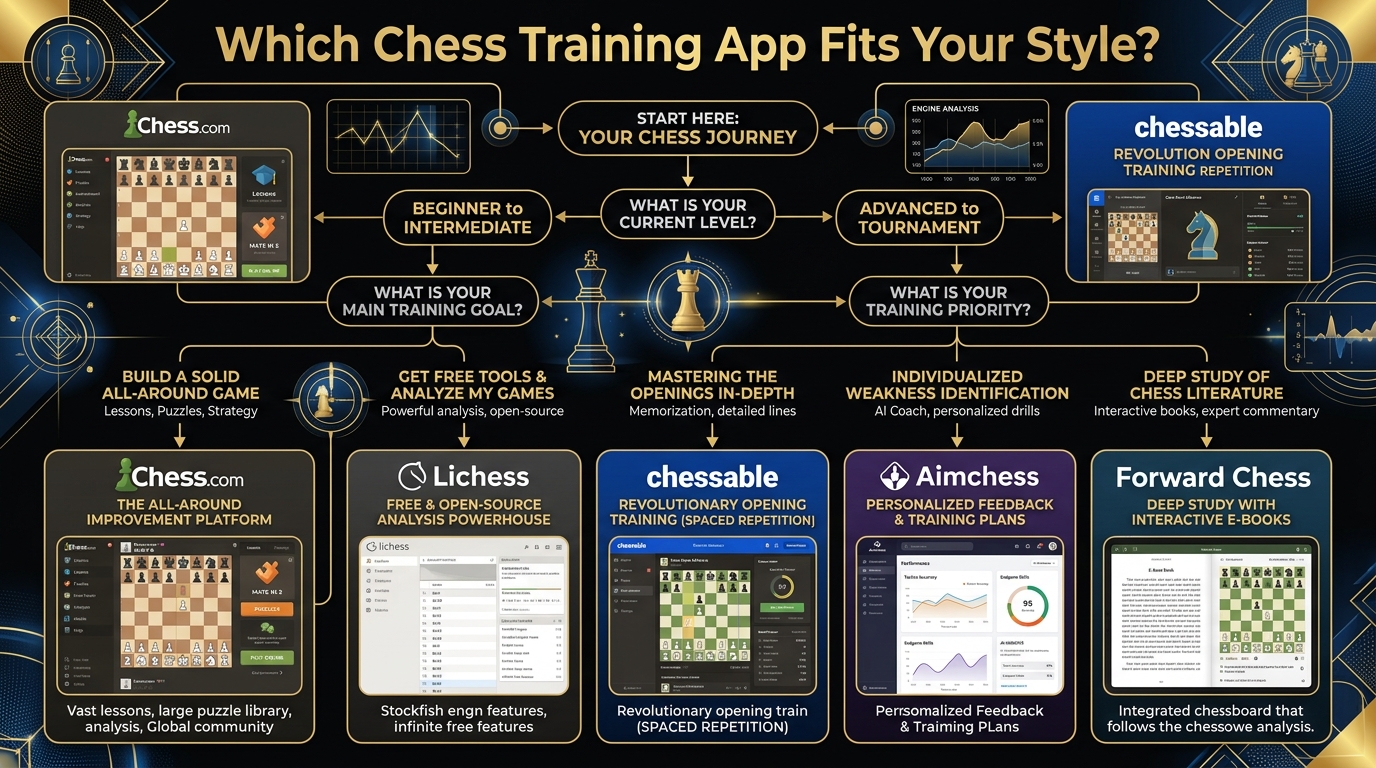
That said, the best app still depends heavily on learning style:
Choose Chessable for serious opening memorization and structured learning.
Choose Chess for the best all-in-one chess platform.
Choose Lichess for the strongest free training ecosystem.
Choose Aimchess for personalized improvement plans.
Choose Forward Chess for deep book-based study.
The biggest lesson from testing these apps is that chess improvement rarely comes from random blitz games alone. The strongest players build pattern recognition gradually through repetition, review, and targeted study — and the best apps finally make that process far more accessible than it used to be.